10 Essential Tools for Tunisian Crochet
Starting with No-Float Tunisian Crochet? The Right Tools Make a Big Difference
When you’re new to No-Float Tunisian crochet, having the right tools can significantly impact your experience and the quality of your finished projects. Below, I’ll list the tools I genuinely use and recommend (I’m not at all affiliated with any of these brands). With these tools, you’ll be well-equipped to get started and ensure your projects are a success:
Double-Ended Tunisian Crochet Hooks
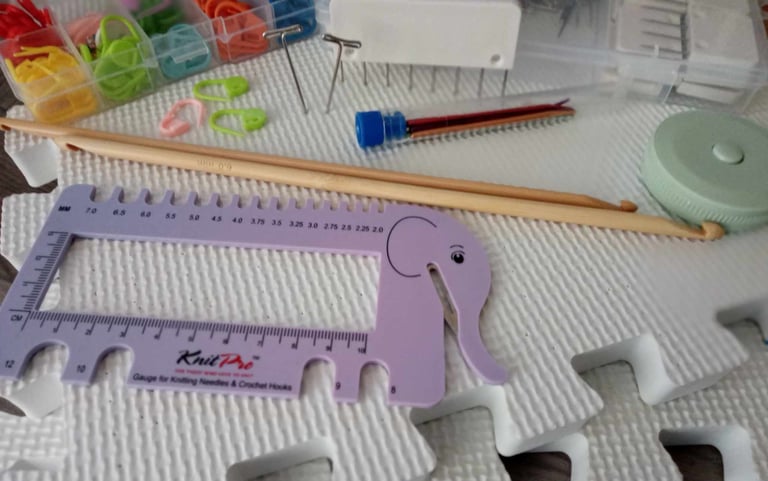
I use these double-ended bamboo hooks because they are the perfect size for working on one section repeat at a time. They are lightweight, come in a handy set of four for different projects, and are relatively inexpensive to buy on Amazon. Admittedly, they did need a little sanding to smooth out some rough spots, but this was easily done with an emery board I had on hand. These hooks are manoeuvrable enough to easily turn around when you’re ready to work the return pass and back again. Additionally, having the same size hook on each end helps prevent confusion.
While you can use hooks with a connecting cord if that’s what you have, be aware that unless you have more than one set, each end will be a different size. If you use connecting hooks, make sure to work the return pass with the smaller hook to avoid your knit stitch becoming too tight compared to the reverse stitch.
Yarn
I have made a dedicated post covering yarn choices, yarn labels, and yarn substitution. You can check it out here for more details.
Yarn Needles
I use yarn needles for weaving in the loose ends of yarn after completing a project. The ones I have come in a handy little tube that you can store with your other tools, so you won’t lose them. Their large eye makes it easy to thread thick yarn or multiple strands, and the blunt end prevents splitting the yarn, ensuring you can tuck those pesky tails away with no problem!
Stitch Markers
Using stitch markers is absolutely essential for the No-Float method. I recommend buying a small box of multicoloured markers like these. Start by using one colour (e.g., pink) to mark the beginning of each round. Use a different colour (e.g., blue) to show where each motif repeat begins and ends. This will help you avoid losing your place and make it easier to keep track of your section repeats.
Tape Measure
A small retractable tape measure is a handy tool to have in your crochet arsenal. It helps you measure things like head circumference for hats or check your project’s length. I originally bought a cheap multipack, but I’ve managed to lose all but one!
Scissors
I use a small, sharp pair of embroidery scissors for my work, which are essential for cleanly cutting yarn. Choose a pair that is comfortable to handle and sharp enough for trimming ends neatly.
Gauge Tool
This tool ensures that your crochet matches the pattern’s tension requirements, which is crucial for achieving the correct size and fit. It helps you measure your stitches and rows accurately, ensuring your project turns out as close to the pattern as possible. If you're unsure about how to check your gauge or why it's important, you can read more about its significance and common issues here.
Patterns and Charts
My patterns are unique and not available anywhere else. Patterns from Rosehip and Hawthorn feature recognisable elements, such as standard Tunisian crochet stitches. However, the way I use these stitches and write them in my patterns is quite different from what you might be used to.
Blocking Tools
I don’t usually block small items like hats that I make for my family, but I do have a set of blocking boards and pins that I use when making something for others. Wet blocking can be particularly helpful in relaxing the fibres, especially if you tend to crochet tightly. However, this can slightly change the size of your item, which could be an issue. So, I recommend making a swatch, wet blocking it, letting it dry, and then checking your tension with a gauge tool. The blocking boards provide a flat surface to shape and set your finished pieces, giving them a more professional finish.
Document Holder
I use a great little document holder that’s ideal for clipping your motif chart and keeping track of the row you’re on using the slider on the side. Besides the bamboo hooks, this product makes the most difference to my crochet experience. I don’t get lost and can see my progress at a glance.
Added Extra: A Notebook
Sometimes, it’s helpful to jot down notes about what went well or what didn’t during a project, so you have a reference for the future. I use mine to record the yarn, hook size, and tension measurements I used. This way, if I make another item with the same hook size and yarn, I know I’ll get similar results based on my previous experience.
With these essential tools, you’ll be fully equipped to start and enjoy your No-Float Tunisian crochet projects. Each item plays a key role in making your crafting experience enjoyable and ensuring your projects turn out as planned. If you have any suggestions for additional tools or if there's something you think I might have missed, please let me know at the email address below :)